
Book Review: The Art of Typing by Ginger Lapid-Bogda
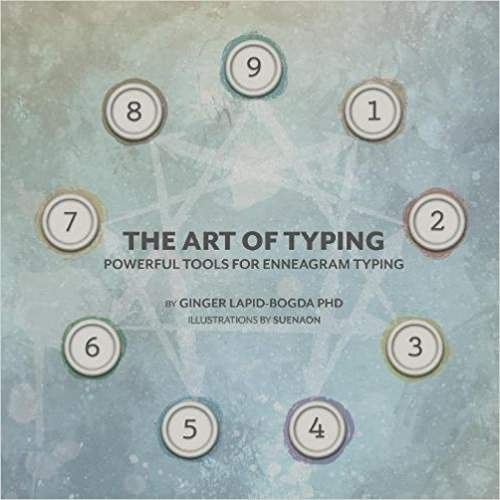
In 2016, Ginger Lapid-Bogda came out with The Enneagram Coloring Book [see my review here], putting a creative, accessible spin on this diamond-sharp model of human behavior. She’s done it again with The Art of Typing: Powerful Tools for Enneagram Typing.
For anyone who’s had a hard time finding their own Enneagram personality type or that of someone else, this book is a great resource. For those who teach the Enneagram or use it as a coaching tool, this book will also be a great aid. I think it’s even a good primer because Ginger and her illustrator, Suenaon, have made clever use of easy-to-understand images and charts to convey important information about the Enneagram in ways that are immediately relatable.
In short, this is a great book for just about anyone.
The book begins with a super-succinct description of what the Enneagram is and distinguishes it from personality [which I’d never seen before] and character. Then there’s an illustrated, two-page layout for each type – again, as a primer or a quick-reference guide for more experienced readers. I particularly liked the section on the “subtypes” (instinctual variants for the Enneagram Institute crowd).
Next, Ginger spends several pages helping us understand various reason why sorting out someone’s type or helping them explore their type possibilities can be difficult. This is gold.
Then we arrive at the meaty center of the book, which is all about distinguishing between types. Anyone who follows Ginger’s blog will recognize this helpful section on differentiating questions. Again, the illustrations are wonderfully accurate. (It’s also kind of funny/sad that because she starts with Type 1, by the time we would get to the section on Type 9, there are no more comparisons to be made – the Nine doesn’t seem to exist! Which tends to be their stance in life.)
But wait – there’s more! The book goes on to reveal other typing factors that need to be considered, such as current stress or anger level, family and culture overlays and more. Another gold section that helps people recognize and overcome their own biases and assumptions so they can know themselves better and be better guides to others.
And don’t skip the appendices. They contain a wealth of goodies, too, like more information on the three Centers of Intelligence, the wings, the arrows and the subtypes (instincts). I had never heard of the concept of “countertype”—the subtype most likely to be confused for another type—but it’s a fantastic bit of information to know when you’re confused about someone’s type.
I also hadn’t heard of some of the Enneagram experts quoted in the book. I love it that I learn new things every time I read a new Enneagram book, even after more than a decade of study, which is why I will continue to read every Enneagram book that comes out.
I can tell that this is a book I’ll come back to over and over again. I heartily and happily recommend The Art of Typing.





Quick Start Guide to Centering Prayer
This short guide gives you the essentials for learning to be still and quiet before God so you can hear his voice and feel his love in a deeper way.
